












Temporary or permanent erosion control: which one does your site require?
A good rain is also the best way to reveal any problems you may have on a construction site. A hillside that appeared solid yesterday may overnight develop several large channels. Dirt appears where it shouldn’t, drains become clogged and the job that was supposed to be straightforward now requires some real cleanup.
It’s the headache most contractors try to head off at the pass.
That’s where erosion control makes a difference. It’s a truly useful method of stopping soil from escaping through wind or water, greatly lessening sediment run-off, and limiting deterioration of exposed ground. But there’s not one method of treatment that is right for all sites. What’s right for your site depends on the individual location, the time frame the area will be exposed and where along the project’s timeline you’re at.
Erosion control usually falls under two categories: temporary, and permanent. Here’s how each of those compares.
Temporary erosion control while the job’s underway
On a busy construction site, everything’s in flux. One section of land is being excavated while another is being prepared for roadworks and drainage. There’s little point trying to get permanent vegetation established in an area that’s going to be excavated next month.
For temporary erosion control, the goal is to hold onto the soil until you’re prepared to take more permanent action.
Mulch can be applied to bare ground to help protect it from the raindrops. Erosion control blankets are another option for protecting slopes, and temporary seeding can be used in areas where construction will not disturb the ground for some time.
Handling water diversion drains divert runoff to keep erosion in check, and check dams are good at slowing down water moving through drainage ditches. You’ll see sediment fences near job sites. They do not control the erosion, but they do prevent sediment from leaving the site.
Admittedly, though, it is only half the work to put the temporary arrangements into place. They require checking, particularly following a storm. A burst fence or a blocked drain isn’t very much use for the next rainstorm, is it?
And when the construction work is finished?
Then the old machinery gets carted away and the site has to start looking after itself.
Here’s where permanent erosion control plays a part. We want to build a surface that can weather the coming years without needing continual maintenance and repairs.
For most, that entails restarting vegetation. Once grass and plants take hold, they do an excellent job of holding soil in place. Their roots are like a net pulling the soil together and above the ground, the cover cushions the impact of raindrops and disperses runoff.
There are instances where plants alone may not be sufficient. Areas of steep slopes or large volumes of water concentrated into a smaller area may require drainage, rock protection or other form of stabilisation.
Why revegetation is not always easy
It may be right for the site, but simply establishing vegetation may prove challenging.
Imagine a freshly mowed roadside batter. The banks are steep, the soil has been disturbed and very little organic matter is left to support plant growth.
Just now suppose you were to scatter grass seed across that slope and sit back and let the forces of nature do their bit.
It would be effective in perfect conditions, but a good storm might carry away most of the seed before it sprouts, and without rain, it’s hard for new plants to get established in dry, crushed-up dirt.
It’s for this reason that revegetation is not just about putting seed into the ground – it’s also about helping the seed get established and out of the ground.
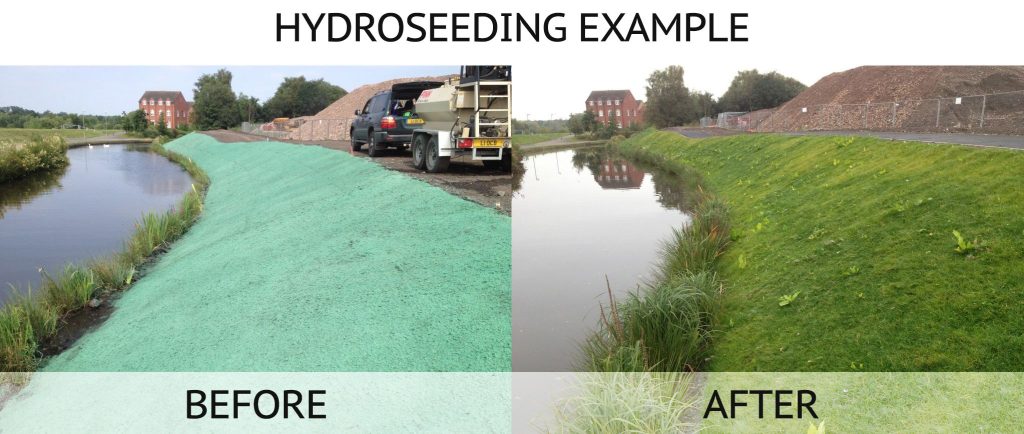
Groundworks employs Eco Blanket® – a compost based erosion control system that is put on exposed ground area to help new plants take root. This is a blend of recycled organic matter, a variety of seed mixes, soil amendments and a degradable tackifier. It is applied with bespoke equipment and provides a layer that aids surface protection and creates a more optimal seedling growing environment.
For challenging sites such as steep batters, road corridors and disturbed land, this can be a better alternative to traditional seeding practices.
Both forms of erosion control might be necessary.
No, it’s not always about selecting either temporary or long-term protection. Sometimes, you need both.
Just a residential subdivision. In the initial phases, earthmoving is being carried out on most of the site. Temporary controls are required to manage runoff and exposed soil whilst the work progresses. When roads, drains and other infrastructure are finished, areas that will not be disturbed again can be permanently stabilised so you aren’t leaving large sections of exposed ground sitting here until the project’s finished.
It’s practical, and it can also go a long way in helping lessen the maintenance and repair work that needs to be done as construction continues.
Never underestimate the repair cost of failed erosion control
It would be tempting to opt for the cheapest erosion control treatment, especially if you already feel tight on your project budget. But erosion control is one of those things where a little saving now can lead to significant costs down the line. When a treatment falls short, you may find yourself needing to replace soil, remove sediment, reinstate drainage and stabilise areas.
Prior to selecting a method you should consider: soil type, slope, rainfall, access to the site and duration of protection.
Occasionally a simple temporary solution will be sufficient. Occassionally it’s cheaper to just buy that more powerful solution from the outset and save a lot of time later.
Talk to Groundworks about erosion control
From exposed ground on a construction site, to a more permanent solution to stabilise a site, Groundworks can assist you.
They assist developers, land managers and civil contractors with revegetation and erosion control work using their own equipment and range of products like Eco Blanket® to address difficult site conditions.
Have a construction project on the horizon? Connect with Groundworks to talk over the specifics of your site and what you can do to prevent erosion from worsening.