















Why Permanent Tooth Replacement Is So Attractive

A lost tooth can be a bigger bother than you might think. Besides the missing tooth, you’ll also see a gap when you eat, speak or smile. And the more you explore the choices, you’ll discover there is more than one way to replace it.
Teeth can be replaced using dentures, bridges, and dental implants. However, in certain cases, the notion of a permanent replacement tooth, anchored onto the jawbone, might be more desirable. This is where dental implants play an important role.
But what exactly is a dental implant?
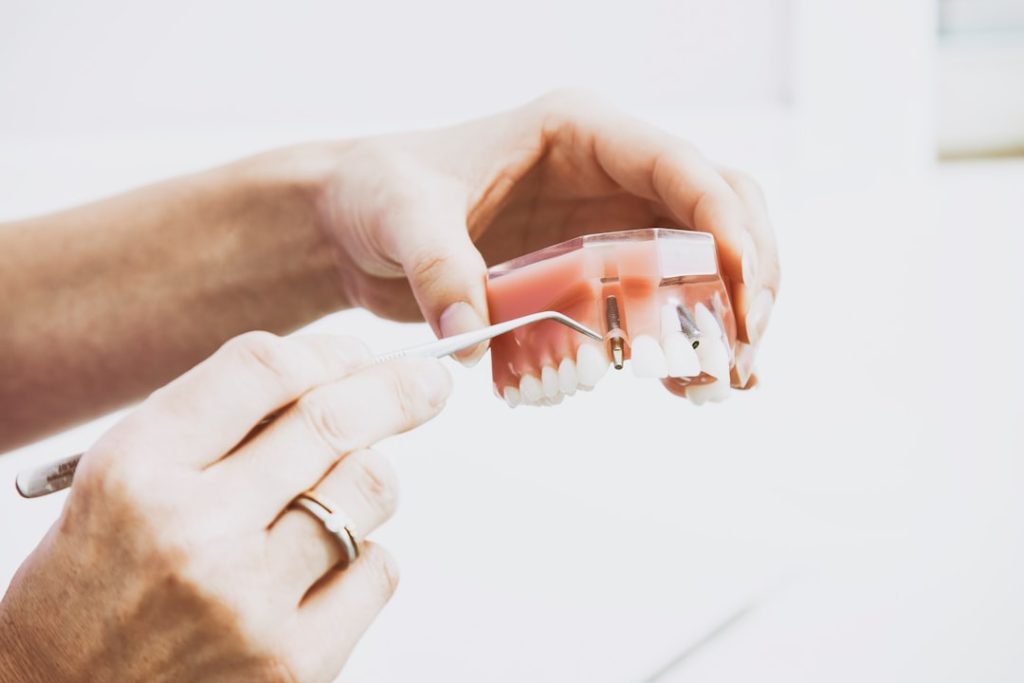
A dental implant is just like a fake tooth root.
The implant is a tiny, screw-like post that’s made of titanium and inserted into the jawbone of the empty space of the lost tooth. As the bone heals, it will connect with the screw. When the implant has healed, a crown or bridge can then be placed on top to provide the replacement tooth.
Therefore, instead of just sitting on the gums, like a removable denture, the implant provides a stable support for the replacement tooth.
Depending on what you need, implants may be used to replace:
- One missing tooth
- Multiple missing teeth
- Several teeth with a bridge supported by a dental implant
- A complete arch of teeth utilizing a series of implants
That’s why they are a quite a flexible choice for replacing your teeth.
What is the reason for selecting implants?
A major difference between an implant and a traditional denture is when you bite.
As a denture is removable, it is more likely to move. Whereas an implant supported tooth is anchored to the jaw for a sturdy base.
Someone who has been living with a loose denture for years or who just doesn’t enjoy the idea of having to take his or her replacement teeth out can do a lot to improve his or her quality of life by having that adjustment made.
You can opt to use implants to stabilise your dentures – this means you may not need to opt for a complete replacement of all your teeth using individual implants. Instead, implants can be used to secure your denture in place.
Certainly, dentures remain a valuable tooth replacement. But whether implants are the right choice for you depends on you – there’s no rule that one replacement is always better than another.
What does the jaw do once a tooth is missing?
Now, there’s another reason why dentists look beyond merely filling the visible space.
A natural tooth root is embedded in the jawbone which provides stimulation when you bite and chew. After you lose the tooth, the bone in that location may undergo some changes.
An implant is an artificial ‘root’ of the tooth that rests in the jaw bone, giving the bone something to support. It also ensures the replacement tooth has a ‘base’ of its own rather than having to rest on the neighbouring teeth.
If you are missing one tooth, this may be one of the reasons an implant can be an alternative to a bridge. Single-tooth implant replacement does not impact the neighbouring teeth as part of the implant.
It’s not a one-appointment solution
While the end results can be as natural looking as a standard tooth, the process can take some time.
To begin with, your dentist must determine if there is an adequate amount of good bone and whether the health of your gums and existing teeth is in condition to undergo the operation. X-rays or even 3D images might be taken to evaluate the space available and program the implant.
The implant is secured into the jaw bone and left to integrate with the bone before being topped with the final crown or bridge.
Bone grafting or similar treatments may be necessary for some people before or during implant treatment.
Therefore, the restoration tooth may appear as quite straightforward, however in the backend there has been a treatment including healing occurring for various months.
Are dental implants really permanent?
You’ll see the word “permanent” a lot when you’re reading about implants, but here’s a good reminder to put it into perspective.
Implants are meant to be a permanent fix and something you don’t just take out for a new one on a regular basis like you can with a normal denture. Won’t let you forget about them once the treatment is over.
You’ve also got to brush and floss daily, and attend your regular dental appointments. After all, your gums and all the surrounding tissue are important.
Poor hygiene and smoking can influence results of the implant treatment, and the quantity and quality of bone may be a consideration in assessing suitability for treatment.
What does treatment actually involve?
Depending on how many teeth need to be replaced and what your mouth requires, there are a few different steps in this process.
Your dentist will examine your gums, teeth and jawbone before coming up with a treatment plan. When the implant has been surgically placed, a healing period will follow while the implant fuses with your jawbone. The crown, bridge or denture can then be fixed in place.
This healing period is one of the major factors that separate implants from faster tooth replacement options. This period can last up to several months, but the duration varies from person to person and procedure to procedure.
That’s why a thorough exam is so important. Bone grafting, for instance, could be recommended if there isn’t sufficient bone to hold the implant.
Is an implant the treatment you need?
There’s no single answer.
If you’re looking for a fixed replacement and are suitable candidates for implant treatment, then implants can be a good choice. However cost, time, bone health, gum health and your general situation all need to be taken into account.
Sometimes another choice might be better.
What’s crucial is to view the full image not selecting treatment solution just because it appears to be like one of the most long term. A dentist will be capable of evaluate your mouth, describe the options and can communicate you through what each individual option will need.
For the right person, an implant can offer a long-term, natural looking alternative and should give you peace of mind that this is going to last you for years to come. However, the best place to start isn’t necessarily with an implant, it’s with figuring out what will actually work for your teeth.