

















Thinking About An Electric Golf Buggy? What To Know

Have you ever lugged your golf bag for 18 holes and wondered if there was an easier way? Check out an electric golf buggy. You can focus on your game instead of your gear by riding along instead of carrying or pulling your clubs.
Despite having many different types of electric golf buggies to choose from, not all of them are intended for the same golfer. Before you start looking at various different batteries, wheels and other gadgets, consider the places that you’ll be using your buggy and what you want it to be used for. Parmaker’s electric golf buggies have a range of different options for those with different needs, including those that are walker-style, and riding-style.
Think about your course first
The local course handbook might be a better guide to your choice than the product brochure.
A buggy on a mainly flat track or course has an easy ride. A buggy on a constantly undulating course, or one with wet terrain, etc., has quite a different life.
Prior to purchase consider:
- How hilly is your usual course?
- Play on uneven terrain often?
- What are the conditions like after rain?
- How long is a round on average?
- Are there any restrictions to electric buggies with your golf club?
Hills may require additional battery power, so a golfer walking a hilly course all the time might need more range than one who frequently plays flatter land. Some features such as appropriate wheels, downhill control and parking brakes may be helpful, depending on the buggy and the course.
Spending a fortune on features you’ll hardly ever utilize isn’t worth it.
Battery choice matters
The battery is one of the less exciting aspects of buying a buggy, but it’s something to consider.
The most common batteries used to power electric golf buggies are lithium or sealed lead-acid batteries. Lithium battery packs tend to be lighter and can provide benefits in the charging and lifespan of the buggies, however, they can be more expensive to buy initially.
Don’t get too hung up on a single “number of holes per charge” figure either. Range can vary significantly from one battery and one buggy to another, and factors such as golf course topography, baggage and operational usage all have an effect.
Whatever you decide, use the manufacturer’s recommended guidelines for charging and storage. The care you take of your battery can impact on its performance.
Just don’t forget your golf bag
This may seem trivial, but it’s so easy to forget when you are all caught up in so many other details.
Evaluate how your bag attaches and if it will fit on the buggy you are looking at. The majority of golf bags and trolleys are made to be used together nowadays but there can always be variances between models.
Don’t forget to consider the buggy’s weight limit, as well as your clubs – you’re not just carrying those clubs. Make sure you add in your balls, drinks, accessories and anything else you’ve got with you as you are dragged around.
How easy is it to transport?
An electric buggy might be perfect on the fairway, but it can also be a pain if you’re struggling to get in your car.
When traveling to the course, consider:
- Folded/Unassembled size
- Overall weight
- How quickly or easily it can fold out or separate
- The amount of boot space it occupies
- Where you’ll store it at home
Parmaker’s motorised golf buggies have been created for transport, with its range able to be collapsed to store in the car. The company has previously claimed that its lightweight buggies can be stored in a car boot.
Something to consider before purchasing. If you play every weekend, you’re going to be carrying that thing in and out of your house a lot.
Is remote control really necessary?
The remote-control buggies are quite tempting. With some models you get to steer and move the buggy from some distance rather than running with it.
That’s definitely a feature some golfers will find useful. For others, probably more technology than they require.
Same applies for extras like GPS and any other electronic bling. If you are going to use them all the time, fantastic. If it’s going to sit unused after the first week, it shouldn’t be what tilts your purchase.
A simple bug that performs the basic function it was designed to do may be the perfect solution.
An electric buggy still needs looking after
Electric doesn’t mean maintenance-free.
Regular care can include:
- Keeping the buggy clean
- Checking wheels and tyres for wear
- Caring for the battery as per the manufacturer’s instructions
- Storing it in an appropriate place
- Having it serviced when required
Servicing schedule really depends on the make and model of the buggy. Hillside Buggies recommends electric buggies need servicing every one to two years or 500 km, whichever comes first, if not riding the buggy correctly.
Another thing to ask yourself about is what happens after you make the purchase. Spare parts, maintenance and repairs aren’t something you’re likely to be thinking about when you hand over your cash, but they are of significantly more concern a few years down the track.
Parmaker has been making golf buggies in Australia for over 30 years and offers after-sales service in its Melbourne factory. Something to keep in mind if you think you may need ongoing support.
Walker or ride-on?
Another fairly basic decision to make is: Do you want to walk or ride?
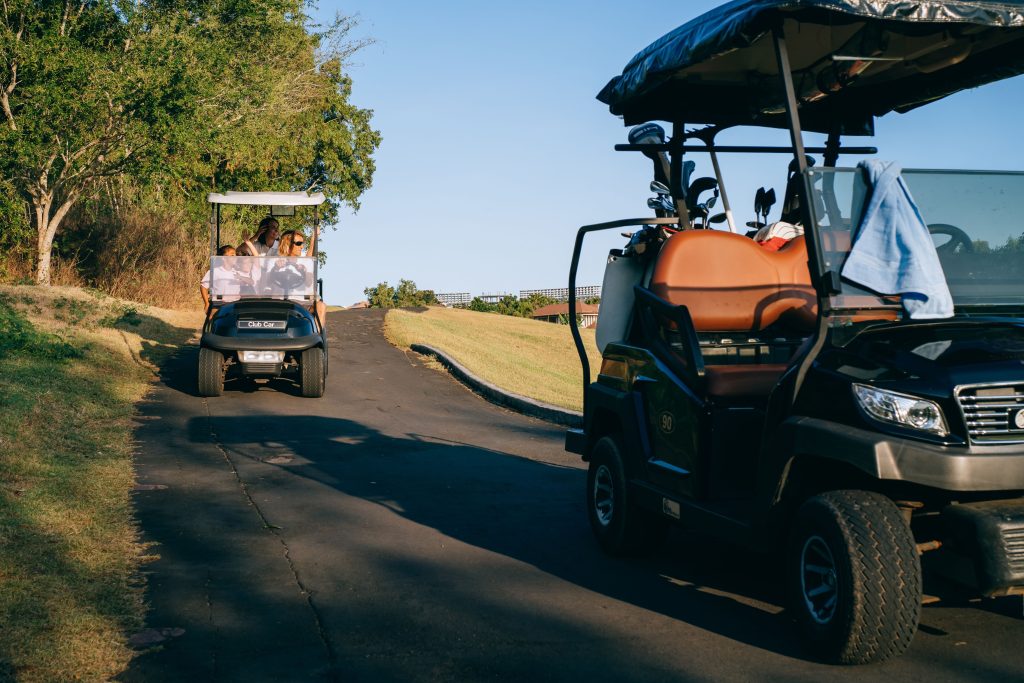
In the form of a walker-style electric buggy you’re still going to be getting around the course by foot, but you won’t have to push your golf bag while doing so. But a ride-on version is a different thing.
Neither is always the perfect answer. Ultimately it depends on the way you like to play, the length and ability of your course and what you wish to get out of your buggy.
So, what should you look for?
Prior to deciding on an electrical golf buggy, it may be worth narrowing issues down to the things which can be actually going to impression your day on the course:
- Course: Watch out for hills, terrain and playing conditions.
- Battery: Check the battery type, charging specifications, and range for the vehicle model.
- Bag: Keep your golf bag secure.
- Transport: measure the folding size and weight.
- Features: Select what extras you will truly make use of.
- Appearance: Decide if you want a ride-on model or a walker.
- Support: Check for servicing, repairs and spares.
- Additional costs: Remember to budget for battery replacement, servicing and accessories.
You don’t need the most expensive golf buggy, or the one with the most gadgets, you need one that is right for your course, your car and the way you play golf in the real world.
Master the fundamentals and an electric golf buggy can do one of the more arduous jobs on the course, leaving you with many more reserves of energy for the 18 holes that count.